Lighting for Garden Lovers: Campbell River Landscaping at Night
LK Installations · · Updated
If you garden, you probably know your yard best in daylight. You know which shrub came from a neighbour’s cutting and which corner the ferns finally settled into. Then the sun goes down, and from the living room window the whole garden turns into one dark shape. In the short days of winter, you may hardly see it at all once you’re home from work.
Garden lighting lets you keep enjoying all that work after dark, and it doesn’t take much. A few well-aimed lights usually look better than a yard full of them. Here are some plain ideas to start with, plus notes on the Gemstone Lights landscape lights we install.
Walk the garden after dark first
Before you decide on anything, go out on a clear evening and stand where you usually look at the garden from, whether that’s the kitchen window, the deck or the end of the driveway. Notice what you miss seeing. For most people it comes down to one or two things: a big tree, a rock wall you built yourself, a bed by the front walk or a pond.
Start with those. You don’t need to light every plant. Pick the few things you’d point out to a visitor and light them well. The rest of the garden picks up some of the glow, and the darker patches in between give your eye somewhere to rest.
While you’re out there, turn around and look at the house and at your neighbours’ windows. A light that seems fine from the lawn can shine straight into a bedroom once it’s aimed upward. That’s easier to sort out at the planning stage.
Trees, shrubs and garden beds
Trees are usually the best place to begin. A tall fir or cedar vanishes completely at night, and one light at the base pointed up the trunk brings it back. A single light gives strong shadows and shows off the bark. For a large tree, or one you see from more than one side, two or three lights placed around it give a more even look and soften those shadows.
Trees that lose their leaves change through the year, which is half the fun. In spring a gentle light picks up the blossom. In summer, a light under the canopy throws leaf shadows across the lawn. Once the leaves drop, the same light shows off the shape of the bare branches all winter.
Shrubs and beds look best lit from a little distance, so the light spreads across them. If a bed has tall plants at the back and short ones at the front, light it from the front or the side so you can still see the layers. Evergreen shrubs are worth the effort because they look much the same in January as they do in July.
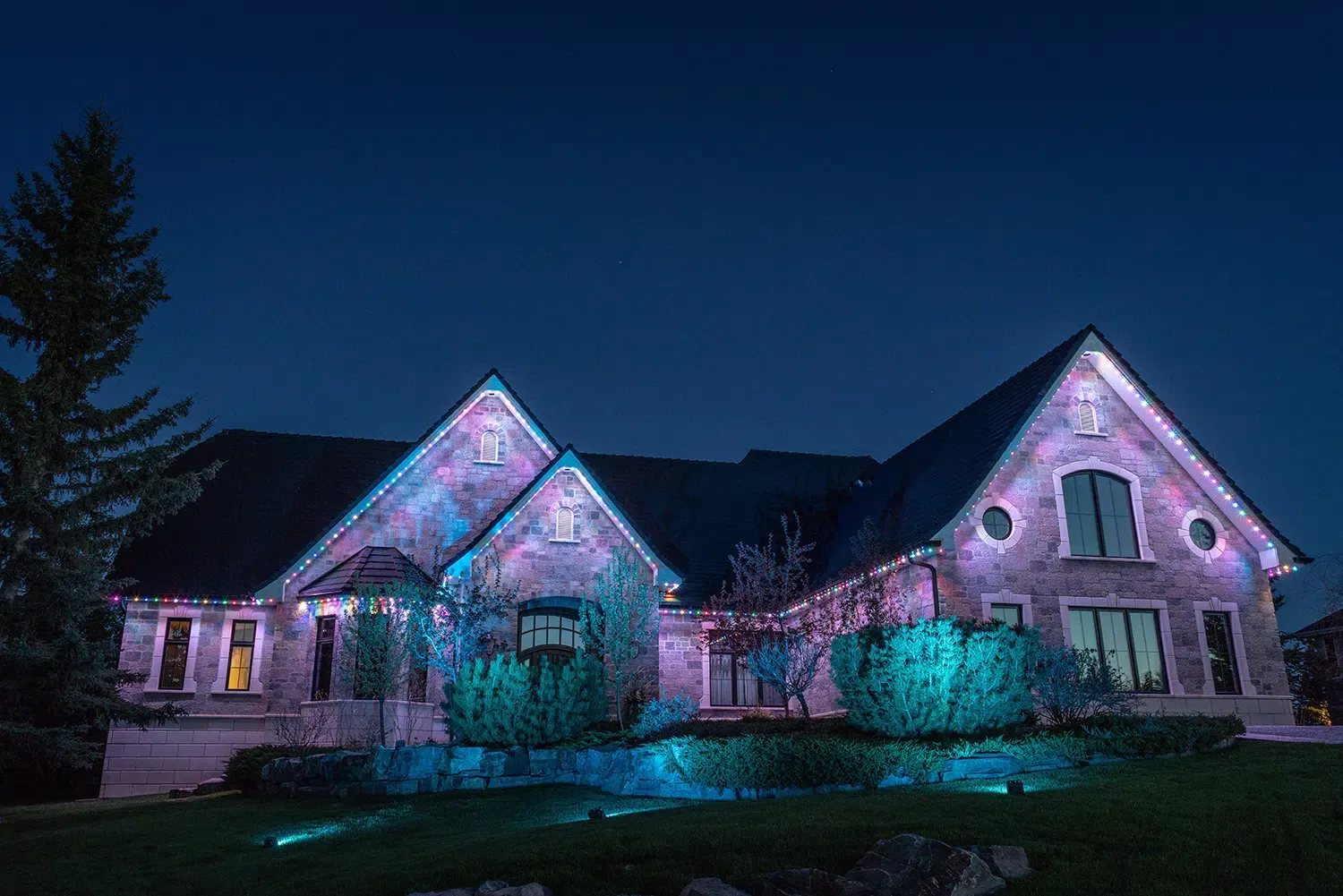
Stone walls and rockeries are easy wins. A light set close to the base of a wall and aimed up along its face brings out the texture of the stone. The photo at the top of this post shows the idea: lights sit in the lawn and point at the shrubs, and the rock wall below them catches some of that light.
If you have a pond or a small waterfall, the water picks up light and reflects it. One light at the edge is often enough.
Light the paths you use
Some of your lights should also be practical. If you go out at night to close the greenhouse or let the dog out, light the route you actually take. Steps and changes in level matter most. Soft, even light along a path is easier to walk by than a few very bright spots with dark gaps between them, especially as our eyes get older.
Watch out for glare. A light that shines into your eyes as you walk toward it makes the ground harder to see. Aim path lights down or across the path, away from the direction people walk from.
If your deck or patio opens onto the garden, it makes sense to plan them together. Gemstone also makes deck lights that sit flush in deck boards and stair treads, and patio string lights for pergolas and seating areas. All of them are controlled from the same Gemstone Lights app.
Warm white most nights, colour when you want it
For everyday garden lighting, warm white is the safe choice. It looks like lamplight and suits both plants and stone. Gemstone lists its warm white diode at 2800K to 3000K and its full white range as 2800K warm white up to 7000K daylight, so you can go cooler if you like a crisper look on green foliage.
The lights also do full colour. Plenty of gardeners never go past warm white, and that’s fine. Colour can be fun in small doses, though, like orange in October or red and white for Canada Day. Changing colours takes a few seconds in the app on your phone, and switching back to warm white is just as quick.
What the Gemstone flood lights are like
Gemstone describes its flood light as a smart LED landscape light. Each one gives off up to 810 lumens and uses up to 18 watts at full bright white, which Gemstone says is plenty for accent lighting. You can also turn the brightness down, so one light can make a soft glow on a small bed while another lights up a big tree.
The lights are staked into the ground, which Gemstone says keeps them in place even with pets, wildlife or wind. Each one is aimed during the install, and the wiring is hidden or buried, so there are no cables lying across your beds in the daytime. The system runs off Gemstone’s power box, which plugs into a standard electrical outlet. Gemstone says the lights are built to handle freezing temperatures, heavy rain and heat, which matters on the coast.
In the app you can split the lights into zones, so the front beds and the back trees can do different things. You can put them on a schedule, for example on at sunset and off at bedtime, so you don’t have to remember. There’s also a music sync mode for when you have people over. Gemstone covers its landscape lights with a 5-year warranty.
If you already have Gemstone permanent roofline lights on the house, you can control the garden lights from the same app, so the house and the garden can come on together. You’ll find more detail on our landscape and flood lights page.
Plan your lighting before the garden goes in
Gemstone says the best time to get a quote for landscape lighting is before your landscaping begins. For gardeners that makes a lot of sense. Burying wire in a bed you’re about to dig is far easier than working around plants that have been growing for years, so if you’re planning a new border or path, think about the lighting at the same time.
An established garden can be lit too. It helps to have a short list ready when you ask for a quote, covering what you’d like to see at night, where you usually look at the garden from and any paths or steps you use after dark. Gemstone notes that the cost depends on the size of your yard and how many lights you need, so starting with a few lights on your favourite parts of the garden keeps things simple.
If you’d like to talk about lighting your garden, call LK Installations at (250) 203-3266 or request a free quote. Tell us what you grow and what you’d like to see from the window at night, and we’ll take it from there.